Graph Equilibrium Radiative Transfer
Radiative heat transfer as an equilibrium on a graph
Graph Equilibrium Radiative Transfer (GERT) treats a radiating domain as a graph. Surfaces and volumes of participating medium are the nodes, and the exchange factors between them are the edges: the fraction of the radiation leaving one element that first interacts with another. Every row of this matrix sums to one, because all radiation leaving an element arrives somewhere.
Ray tracing gives the exchange factors, following each ray only to its first interaction. Everything after that, every reflection, scattering event, absorption and re-emission, is resolved by a single linear system. Its solution is non-negative, and it conserves energy to machine precision as an algebraic identity, however well or badly the exchange factors were sampled. Monte Carlo sampling leaves the factors slightly out of balance with each other, so they are first projected onto the set of matrices that satisfy reciprocity and energy conservation exactly, which removes much of the sampling noise as well.
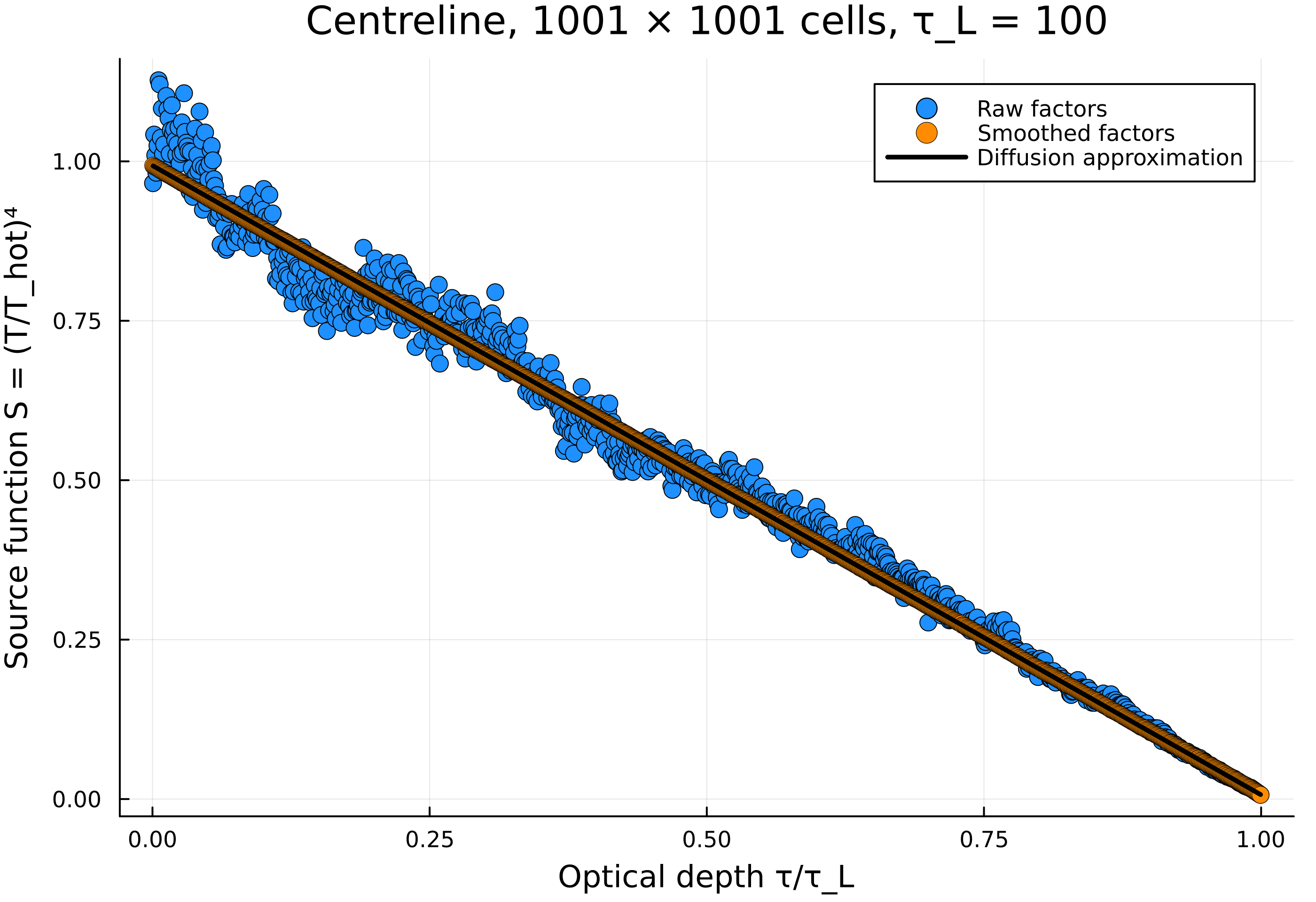
The methods are implemented in RayTraceHeatTransfer.jl, a registered Julia package. It handles grey, spectral and directional problems in two-dimensional participating media, and surface exchange in three-dimensional enclosures.